
Protect Pipestone from the Magellan / ONEOK Pipeline
Minnesota’s Public Utilities Commission is currently accepting public comments on a proposed petroleum pipeline threatening the Pipestone Quarry in what we now call Southwestern Minnesota. Pipestone is sacred. The red stone quarried there carries deep cultural, spiritual, and historical meaning for Indigenous peoples and must be respected and protected for generations to come. The Rise & Repair Alliance calls for abandoning attempts to re-open this pipeline and for decision-makers to honor their responsibility to safeguard sacred land, public safety, and our collective futures.
NOTE: COMMENT PERIOD EXTENDED!
On Wednesday, June 17th, 2026 Minnesota’s Public Utilities Commission (PUC) issued a Notice of Extended Comment Period at the request of the Minnesota Indian Affairs Council (MIAC). The comment period deadlines below have been updated!
Submit a Comment
Minnesota’s Public Utilities Commission is currently accepting comments on the Pipestone Docket regarding this questions:
What action should the Commission take regarding Magellan’s Phase I Inventories for RA-01 and RA-03 Compliance Filing?
What action should the Commission take concerning the routing permit for the proposed Pipestone Reroute Project?
[Extended] Comment Period Deadlines
August 21, 2026 at 4:30 p.m. - Initial comment period closes
Sept. 4, 2026, at 4:30 p.m. - Reply comment period closes
Sept. 11, 2026, at 4:30 p.m. - Supplemental comment period closes
PUC Docket Information
Docket #: IP-7109/PPL-23-109
Sample Comments
-
I am writing to ask you to reject OneOk Magellan’s proposed pipeline near the Pipestone National Monument in Docket 23-109.
Beyond its historical and present importance to the spirituality and culture of Indigenous people in Minnesota and across the Plains, the Pipestone National Monument and the broader environment around it would face significant threats from the construction and potential spill from the proposed recommissioning of this pipeline.
The Sioux Quartzite that rises to the surface in the Pipestone area contributes to microecosystems for rare plants including the endangered Hairy Waterclover. The area also offers some of the only native prairie land left in Minnesota, which could be irrevocably damaged by the development of this pipeline or a potential spill.
This pipeline isn’t necessary: it was decommissioned more than 4 years ago and our Minnesota communities haven’t seen an impact. I urge you to preserve this site of ecological and spiritual importance over the potential profits of an unnecessary pipeline.
Our Minnesota communities need to move away from harmful extraction and towards a respectful relationship with the land around us. The threats to this site and the surrounding environment and ecosystem are too grave. We ask that the PUC reject this permit, pipeline, and choose the no-build alternative!
-
Please uphold treaty rights by denying any permit for a Magellan pipeline near Pipestone National Monument in Docket 23-109.
In 1858, the United States guaranteed the Ihanktonwan Dakota Oyate (called the “Yankton Sioux Tribe” by the U.S.) perpetual “free and unrestricted use of the red pipe-stone quarry” in exchange for releasing the right to occupy about 11 million acres of land in what we now call South Dakota. The Ihanktonwan Oyate fulfilled their promise. Now, the PUC must not allow Magellan to break the promise of the U.S.
Building a petroleum pipeline through the sacred pipestone landscape necessarily infringes on the unrestricted use of this stone, and risks compromising burial sites. Even a route around the Pipestone Reservation burdens the quarry because the rock and its historic use does not follow survey lines. As Faith Spotted Eagle of the Brave Heart Society has explained, “These areas hold cultural resources and potentially burials of Indigenous ancestors, and the closer the proximity of a route to the Sacred Site/Monument, the denser cultural resources are likely to be.”
Magellan asks the PUC to place private profit over public promises. But promises made in treaties like this one are the “supreme law of the land” under article VI of the United States Constitution.
Please honor the U.S. Constitution, the 1858 Treaty, and the centuries of Indigenous use of the Pipestone Quarry and landscape by denying any permit for a Magellan pipeline near Pipestone National Monument. We ask that the PUC reject this permit, pipeline, and choose the no-build alternative!
-
I am writing to ask you to reject OneOk Magellan’s proposed pipeline near Pipestone National Monument in Docket 23-109.
For more than 3000 years, the Red Rock Ridge that forms the area now known as Pipestone National Monument has been sacred to Indigenous peoples and tribes across the United States. The catlinite quarried here is central to Tribal Nations' Indian Religious Freedom. It is so culturally and geologically sensitive that the US only allows enrolled tribal members to mine the catlinite, and then only with approved hand tools.
Less than a century ago, the Indian Religious Freedom Act was passed in 1978. This paved the way for tribal citizens to participate in ceremonies central to their identity and culture, and recognized that past policies have “resulted in the abridgement of religious freedom” for Native people. The sacred pipestone is central to ceremonies of tribal nations and part of the connection to the spirit world and the creator. Today, Magellan asks you for the state-permitted right to abridge Indigenous religious freedoms once more.
Take a brief look back at US history, and you will see the forced assimilation and genocide that were committed against an entire race of people in our country. We must choose to do better! This harmful history risks repeating itself if we do not stop this egregious act.
As a person of faith and conscience, I believe in the inherent right of all people to practice their religions and traditions and the obligation of our state to protect sacred spaces from harm. That’s why I urge you to deny Magellan’s request for a rerouted pipeline near Pipestone Monument and across the Red Rock Ridge. We ask that the PUC reject this permit, pipeline, and choose the no-build alternative!
-
I write to ask you to deny all permits for a Magellan pipeline near Pipestone National Monument in Docket 23-109.
I encourage you to really look into what is taking place and what is at stake. Indigenous Nations' connection to the land is vital to their existence and identity, and protecting it at this moment is of the utmost importance. Indigenous nations and their homelands and treaty territories are home to some of the world’s last remaining biodiversity.
Protecting Indigenous lifeways and rights means protection for the web of life. Tribal Nations' very identity is being threatened by this pipeline. No one should have to fight this hard just to be who they are. If this pipeline leaks, it could destroy the sacred stone that connects Indigenous people to the creator and our ancestors. The pipe is at every ceremony. It is part of how people pray. It is part of how people travel on to the spirit world. It is a part of their past, present, and future—this sacred site cannot be replaced. It is the only place in the world where people can gather this sacred stone.
This area was and still is protected by treaty, which are the supreme law of the land under Article VI of the United States Constitution. Indigenous ancestors fought hard to protect spaces like these so they could be enjoyed by future generations. It is our responsibility as Minnesotans to ensure that their hard work is respected, and this site is protected! “In the 1858 Treaty with the Yankton Sioux, the U.S. recognized the Yankton Nakota's exclusive ownership of a square mile around the pipestone quarries.” (Carleton) Tribal nations allowed for the state of Minnesota to be built through treaties like these, and it is Minnesota’s job to ensure these are upheld. The proposed pipeline falls within the area protected by the 1858 treaty. The treaty of 1858 states, “"The said Yankton Indians shall be secured in the free and unrestricted use of the red pipe-stone quarry, or so much thereof as they have been accustomed to frequent and use for the purpose of procuring stone for pipes; and the United States hereby stipulate and agree to cause to be surveyed and marked so much thereof as shall be necessary and proper for that purpose, and retain the same and keep it open and free to the Indians to visit and procure stone for pipes so long as they shall desire." (Tribal Treaties Database)
This site was also home to a boarding school and may contain burial sites from this time! It is important to let those little spirits rest for all of eternity. They have been through enough, and deserve to be at peace. We ask that the PUC reject this permit, pipeline, and choose the no-build alternative!
Options for Submitting a PUC Comment
Comments can be submitted to the Minnesota Public Utilities by email, US Mail, or submitted online via the online comment portal. Including the docket number is important on each of these options! Minnesota’s PUC also has guidance for submitting a strong public comment available here.
Comments by Email: Send to consumer.puc@state.mn.us with “Public Comment on Docket #: IP-7109/PPL-23-109” in the Email Subject
Comments by US Mail: Minnesota Public Utilities Commission, 121 7th Place East, Suite #350, Saint Paul, Minnesota, 55101
Comments using the PUC’s Online Comment Form: https://mn.gov/puc/get-involved/public-comments/comment-form/ (Or Click the Button Below!)
Other Notes:
We encourage you to focus your comment on the shortcomings of MAGELLAN, the pipeline company, and not direct anger/resentment at the PUC Commissioners.
You can include attachments as PDFs with your online submission. We encourage a including, and referencing, the NCAI resolution on Free, Prior & Informed Consent with your comment! View the NCAI FPIC Resolution PDF Here.
~ Pre-written Action Alerts / Comments ~
Several advocacy organizations have created simple ways to submit a pre-written comment onto the PUC docket in just a couple of clicks:

Additional PUC Quick Links & Resources
Lookup & View Existing Comments in the Docket
All comments submitted to the PUC are publicly viewable. You can view comments submitted by entering the docket number (23-109) into the PUC’s eDocket System or by Clicking Here.
About Pipestone Quarry
Pipestone is a sacred place central to Indigenous spiritual life and cultural continuity. For thousands of years, Indigenous peoples from many Tribal Nations have traveled from across the plains and beyond to this land to pray, walk in peace, and quarry red pipestone for sacred ceremonial use.
“Archaeological evidence shows that quarrying here has extended over 3,000 years, and this practice continues today under Tribal and federal protections that recognize the site’s spiritual importance.”
Source: Pipestone National Monument (U.S. National Park Service)
The red pipestone (catlinite) quarried here is used to carve the sacred peace pipe, a prayer instrument that carries prayers to the Creator and is integral to Indigenous ceremony and spiritual life. These pipes are used in healing, agreement-making, mourning, and to give thanks, and remain central to ceremony among many Indigenous peoples.
This land was also the site of the Pipestone Indian Training School, a federal boarding school that operated from 1894 until 1953 and was part of a broader system of forced assimilation that removed Indigenous children from their families and cultures (Report finds Native American boarding school deaths are more than government report). Historians and community advocates have documented that children died while attending this school, and there are longstanding concerns that unmarked burial sites may remain in the landscape (Hidden History: Federal investigation generates new interest in Minnesota's American Indian boarding schools - KSTP.com 5 Eyewitness News).
For Indigenous communities, Pipestone is both a place of profound living spirituality and a place of remembrance and intergenerational trauma. Its continued use for prayer and ceremony, and the memory of children who did not survive the boarding school system, all underscore the urgent need to protect and honor this land for future generations.
The Magellan Pipeline ran through Pipestone National Monument until it was shut down in 2022. Since that time, our state has continued to function without it, demonstrating clearly that this pipeline is not necessary. Now is not the time to invest in new fossil fuel infrastructure or to permit the expansion or rerouting of pipelines that carry inherent risks and perpetuate harm.
This moment calls for a decisive break from the destructive practices of the past. It is time to move toward healing—of the land, of our climate, and of our relationships with the Earth and with one another. Although the proposed Magellan reroute would bypass Pipestone National Monument, it would still carry the same explosive risks and environmental dangers that threaten nearby communities, waterways, and ecosystems.
~ Partner & Community Resources ~
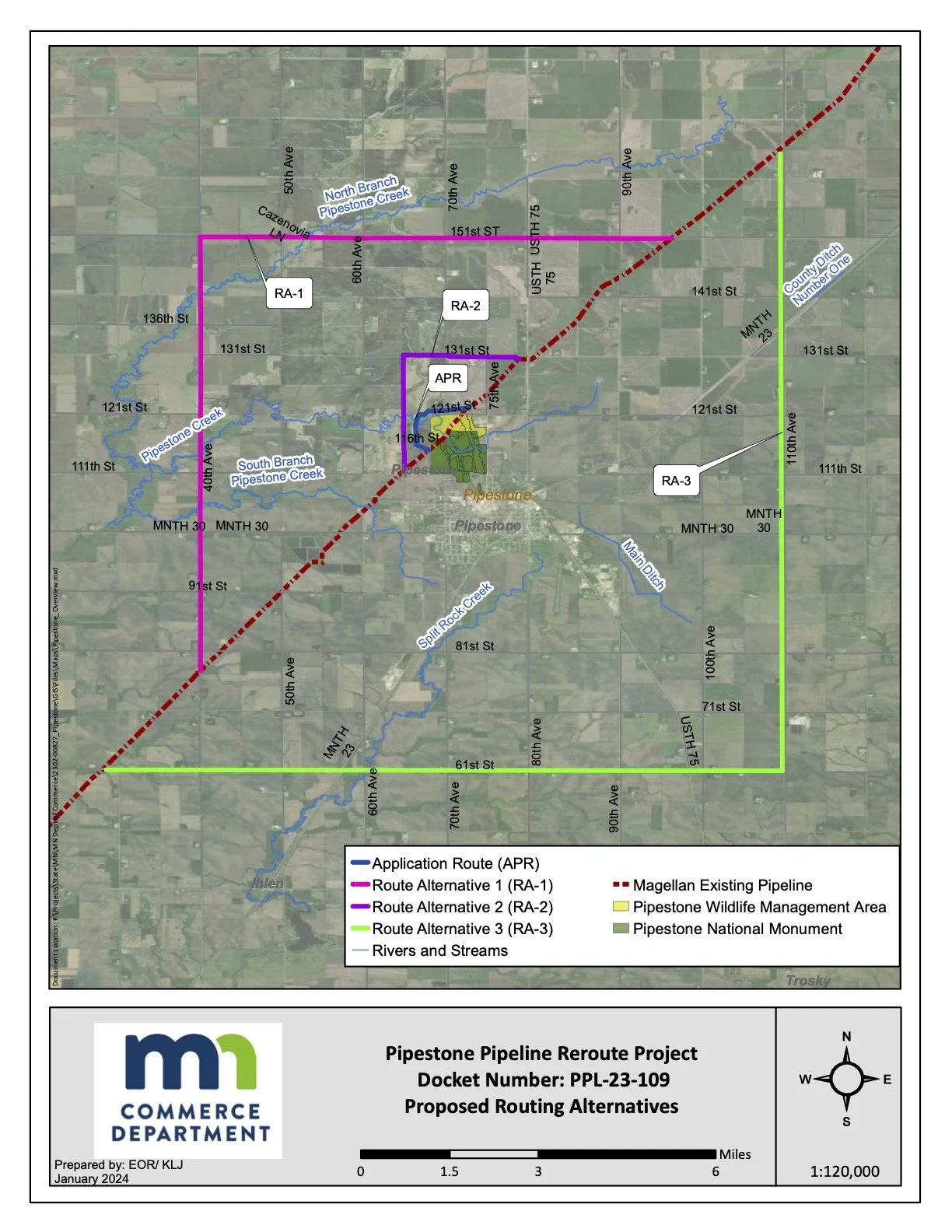
Below are several graphics, resources, fact-sheets, and organizations to follow & support who are working to protect Pipestone.
Quick Links to Community Groups & Pages
Indigenous Environmental Network (IEN): Website | Facebook | Instagram | Youtube
Indigenous Protector Movement: Facebook Page | Website
Native Organizers Alliance: Website | Facebook Page
The Red Stone Movement
The Red Stone Movement is a growing collaboration of community organizations and tribal governments working to protect Pipestone.
The graphics below were published on social media as a collaboration with Brave Heart Society and Native Organizers Alliance Action Fund. The original Facebook post is available by clicking here ~ please share it!
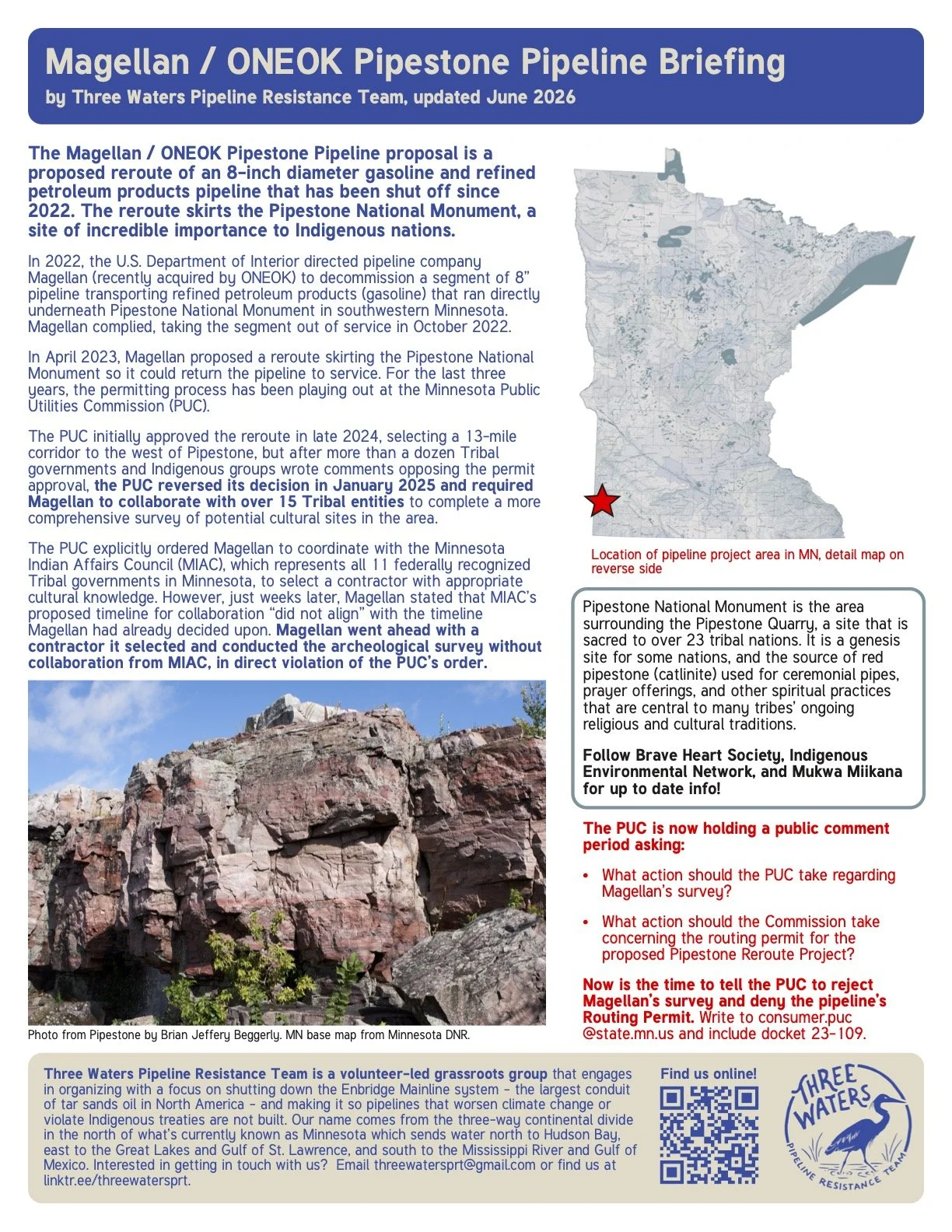
Three Waters PRT Factsheet
Three Waters Pipeline Resistance Team’s Magellan / ONEOK Pipestone Pipeline Briefing Factsheet is a printable 2-page PDF providing an overview of the regulatory process and information on submitting comments to the PUC.
Webinar Recording
PROTECT PIPESTONE, STOP THE PIPELINE!
The Indigenous Environmental Network (IEN) hosted a webinar on June 11, 2026 featuring Leanna Goose of the Rise & Repair Alliance and Ernest “Joey” Oppegaard-Peltier of MUKWA. What the recording below (Starts at 21:41)!